Densha de Go! Plug & Play: Complete Architecture of the Original Game
dgf, the ARM Linux binary that powers
Taito's 2018 Densha de Go! Plug & Play TV game unit, produced by decompiling the
original executable in Ghidra and Binary Ninja, cross-checked against live runs of the
unmodified game. Written for players, fans, and anyone who wants to rebuild this game from scratch.
What this report is
In 2018, Taito shipped Densha de Go! Plug & Play, a palm-sized HDMI
“TV game” containing a complete remake of the classic 1996 train-driving arcade game.
Unlike the arcade boards and consoles of the series' history, this unit is a small
embedded Linux computer: an Allwinner R16 quad-core Cortex-A7 SoC with a Mali-450 GPU,
booting Linux 3.4 and running a single 8 MB ARM executable named dgf.
This report dissects that executable. Every claim below was produced by one of three methods, and each section says which:
- Static decompilation. The binary was analyzed in Ghidra and Binary Ninja; their pseudo-C outputs (shown throughout) were cross-checked against each other. The binary ships with 57,000 symbols from its original build, which anchors nearly every function to its real name.
- Live execution. The unmodified game was run on desktop Linux through a thin hardware-emulation shim (EGL/X11, evdev, CedarX video), and driven with a keyboard mapped at the original controller's evdev boundary. All game screenshots in this report come from those live runs.
- Data autopsy. The 1.6 GB
Data/asset tree was parsed: archives, textures, schedules, and save files were decoded byte-by-byte and the decoders verified against the loaders found in the binary.

dgf binary running on desktop Linux through the hardware
shim; the title screen plays a live-action E231 video behind the logo. Every screenshot in
this report is captured this way unless noted.Who this is for
Three audiences, three levels of depth, all in the same sections:
| Reader | What to read | What you'll get |
|---|---|---|
| Curious fan | Every section's opening paragraphs and figures | How the game actually works: one frame of gameplay, start to finish |
| Train-game enthusiast | Physics, scoring, departure/arrival chapters | Exact formulas, tables and thresholds the game judges you by |
| Reimplementer | Everything, plus the Appendix and the Reimplementation Guide | Addresses, struct layouts, file formats, and a build order that works |
The report map
The game decomposes into clean layers, and so does this report. Read in order, or jump:
One frame of the game, end to end
Before the chapter-by-chapter breakdown, here is the shape of the whole machine. At 60 Hz, the game:
- Copies the game condition bit-field that gates every subsystem this frame;
- Runs the current map mode (departure choreography, driving, arrival, results), each a small state machine;
- Translates controller state into notch/brake positions through a safety-gated input chain;
- Integrates one physics step: traction minus four resistance models, brake precedence, jerk penalty;
- Runs the ATS/ATC signal logic against the track layout ahead;
- Judges the player against profile tables for speeding, late arrival, stop position and driving manner;
- Records the frame as a draw-packet stream, which the render thread interprets into GLES 2.0 calls.
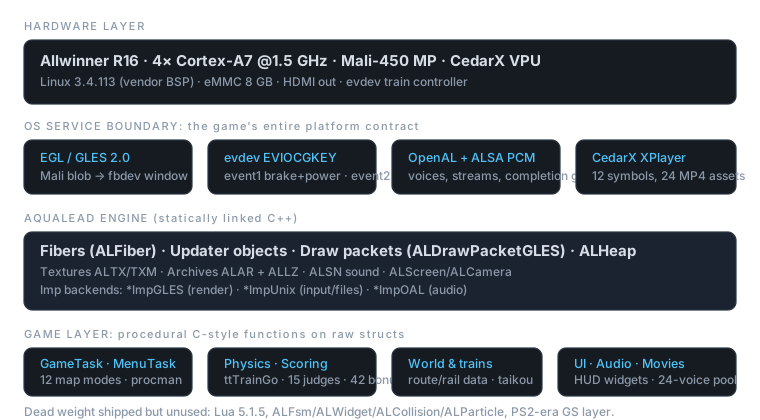
Each of those seven bullets is a chapter of this report. The diagram below shows how the executables' layers stack:
CamelCase come from the binary's own symbol table; DAT_xxxxxx /
data_xxxxxx are unnamed globals at their fixed addresses (the binary is non-PIE, so
addresses are stable and meaningful). Where Ghidra and Binary Ninja disagree, both are shown.